
Which Materials Are Magnetic?
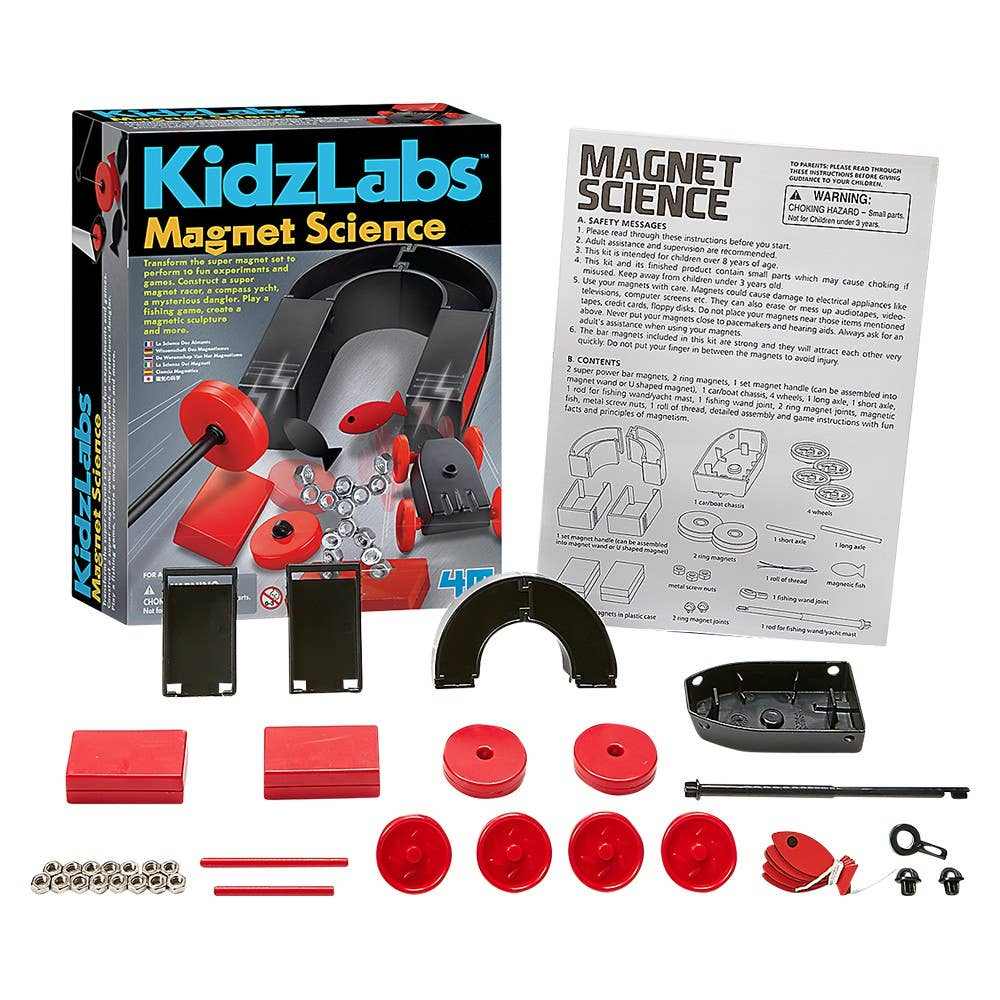
Kit for This Project
Ready to test your ideas? Grab the kit used in this experiment and start discovering!
The Big Question
Which everyday materials are attracted to magnets, and what do magnetic materials have in common?
Make Your Prediction
Do you think all metals are magnetic? Will a magnet attract a paper clip, aluminum foil, a coin, or a plastic spoon?
You might be surprised by what sticks and what doesn't!
My Hypothesis: I predict that __________ will be attracted to a magnet because __________.
I predict that __________ will not be attracted to a magnet because __________.
What You'll Need
• A strong, child-safe magnet
• Steel paper clips
• Iron or steel nails
• Aluminum foil
• Copper wire or copper pipe fitting
• Coin
• Plastic spoon
• Wooden craft stick
• Rubber band
• Small piece of fabric
• Notebook and pencil
• A tray or flat testing surface
Rubber Ducky Dojo Tip: Collect objects made from different materials! Include several kinds of metal, along with plastic, wood, rubber, and fabric.
Safety First: Use only intact, child-safe magnets with adult supervision. Keep magnets away from young children, pets, and anyone who might swallow them. Never use loose high-powered magnetic balls or small detachable magnets.
Let's Experiment!
Let's Get Magnetic!
- Gather Your Materials: Collect at least eight everyday objects made from different materials. Place them on a flat testing surface.
- Make Your Predictions: Before testing anything, predict which objects will be attracted to your magnet. Record your guesses.
- Start Your First Test: Place a steel paper clip on the table. Slowly move your magnet toward it without touching it.
- Watch Carefully: Does the paper clip move toward the magnet? Does it stick when the magnet touches it?
- Record Your Discovery: Write down whether the object was attracted to the magnet.
- Test More Materials: Repeat the experiment using aluminum foil, copper, a coin, plastic, wood, rubber, and fabric.
- Repeat Your Tests: Test each object three times using the same magnet and testing method.
- Sort Your Results: Separate your objects into two groups: magnetic and nonmagnetic.
- Look for Patterns: What do the magnetic objects have in common? Were all the metal objects magnetic?
- Draw Your Conclusion: Compare your results with your original hypothesis. What did you discover?
Bonus Challenge: Can a magnet attract a paper clip through a sheet of paper or a piece of cardboard? Try placing different nonmagnetic materials between the magnet and the paper clip!
Safety Reminder: Keep magnets away from electronic devices, magnetic cards, and sensitive medical devices such as pacemakers.
What Are We Measuring?
Every great science experiment has variables!
Independent Variable (What You Change):
The type of material being tested.
Dependent Variable (What You Observe):
Whether the material is attracted to the magnet.
Controlled Variables (What Stays the Same):
- Same magnet for every test
- Same starting distance from each object
- Same testing surface
- Same testing method
- Same number of trials
- Similar-sized objects when possible
Why Does This Matter?
By changing only the material being tested, you can discover which substances respond to magnetic forces.
Keeping your testing conditions the same helps make your experiment fair and your results more reliable!
The Science Behind It
The Science Behind the Attraction!
Have you ever wondered why a magnet sticks to a refrigerator but won't stick to a wooden table?
It's all about a fascinating invisible force called magnetism!
What Is Magnetism?
Magnetism is a force that can attract or repel certain materials without touching them.
Every magnet produces an invisible magnetic field around it. This field allows magnets to exert forces on certain objects even from a distance!
Which Materials Are Magnetic?
Some materials are strongly attracted to ordinary magnets because of how their atoms behave.
Three important magnetic elements are:
- Iron: Found in many nails, tools, and steel objects.
- Nickel: Used in certain alloys and industrial products.
- Cobalt: Used in some powerful magnets and specialized equipment.
Steel often attracts magnets because it contains iron, although not every type of steel responds strongly.
But Aren't All Metals Magnetic?
Here's the surprising part: Not all metals are attracted to magnets!
Aluminum, copper, gold, and silver are not strongly attracted to ordinary magnets.
Even some stainless steel objects aren't magnetic!
That means an object being made of metal doesn't automatically make it magnetic.
What's Happening Inside the Material?
Atoms contain tiny particles called electrons that contribute to magnetism.
In ferromagnetic materials, such as iron, groups of atoms form magnetic regions called domains.
When a magnet comes nearby, these regions can become more aligned, causing a strong attraction.
In most everyday nonmagnetic materials, this strong attraction doesn't happen.
The Big Discovery: Whether an object is magnetic depends on the material it's made from and how its atoms respond to magnetic fields—not simply whether it's made of metal!
Real-World Connection:
Engineers use magnets in incredible ways!
- Electric motors use magnetic forces to create movement.
- Recycling centers use powerful magnets to separate iron and steel from other materials.
- Speakers use magnets to help produce sound.
- Magnetic levitation trains use magnetic forces to help lift and move trains.
When you test which materials are magnetic, you're investigating the same science used in robots, electric motors, and modern transportation!
Ready to Be a Scientist?
Every great scientist records their discoveries! Download your free experiment worksheet to make a prediction, track your results, and explain what you learned.


