
Which Cardboard Bridge Design Is Strongest?
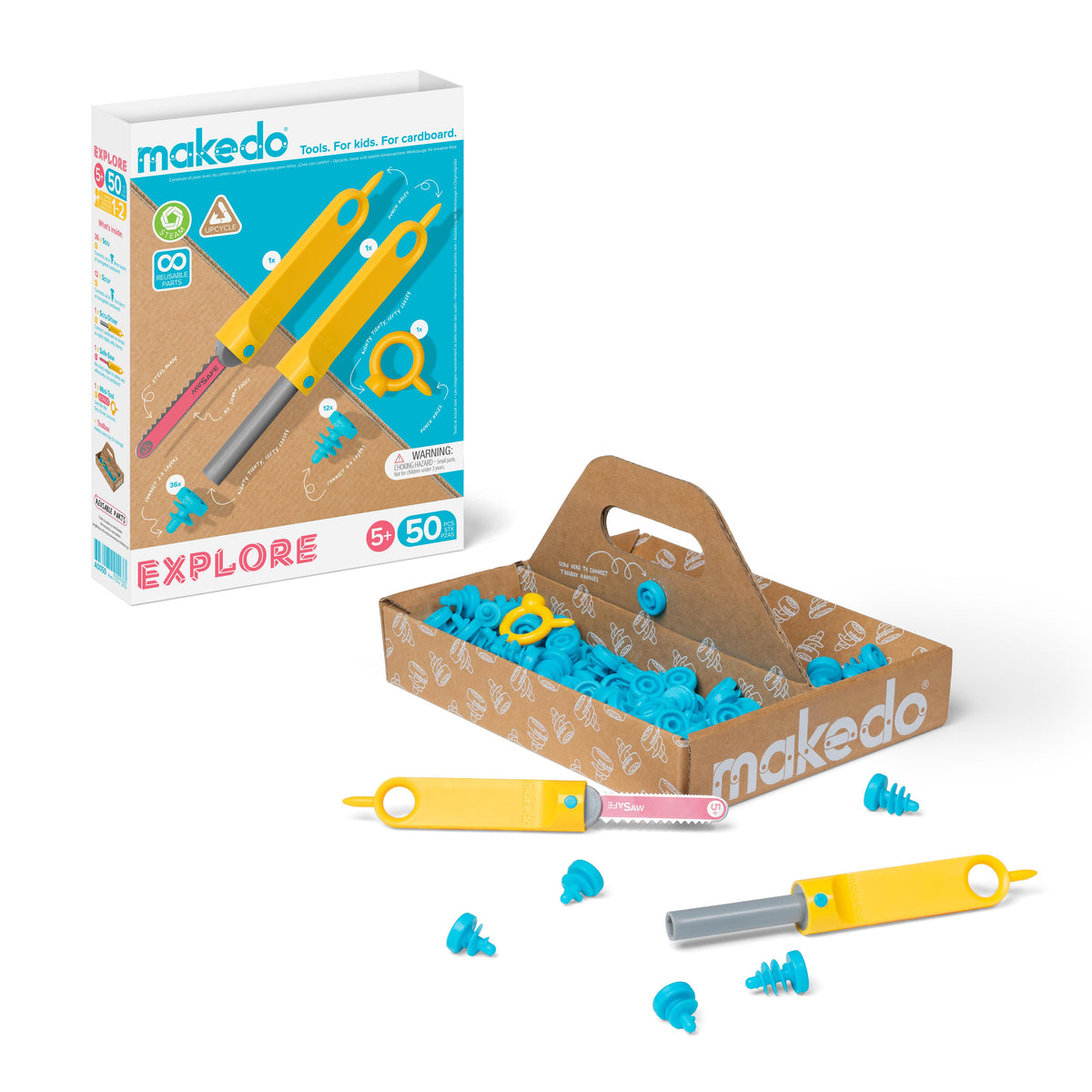
Kit for This Project
Ready to test your ideas? Grab the kit used in this experiment and start discovering!
The Big Question
How does the design of a cardboard bridge affect how much weight it can support before bending or collapsing?
Make Your Prediction
Have you ever wondered how bridges support the weight of cars, trucks, and even trains?
What if you could build your own bridges using nothing but cardboard and a few clever engineering tools?
Do you think a flat bridge will be stronger than one with folded supports? What about a bridge built using triangles?
My Hypothesis: If I build a bridge using a __________ design, then it will support the most weight because __________.
What You'll Need
• Makedo Cardboard Construction Kit (Explore, Discover, or Create)
• Recycled corrugated cardboard boxes
• Makedo Safe-Saw and Scru-Driver
• Makedo Scru connectors
• Ruler or measuring tape
• Pencil
• Two sturdy, equal-height supports (such as stacks of books)
• Small paper cup or lightweight container
• Identical coins, washers, or other small weights
• Kitchen scale (optional)
• Notebook and pencil
• Adult supervision
Rubber Ducky Dojo Tip: Use cardboard from the same box for all three bridge designs! Different cardboard thicknesses can affect strength, so using the same material makes your experiment more accurate.
Safety First: Have an adult supervise cutting and construction. Keep fingers away from the Safe-Saw's cutting path, and use only small, manageable weights when testing your bridges.
Let's Experiment!
Let's Build Some Bridges!
- Become a Bridge Engineer: Look at pictures of real bridges. Notice how some use flat beams, others use folded or box-shaped supports, and many use triangular structures called trusses.
- Design Three Bridges: Sketch three bridge designs you want to test:Bridge A: A flat cardboard beam.Bridge B: A folded, U-shaped cardboard beam.Bridge C: A triangular or truss-inspired cardboard structure.
- Prepare Your Materials: Use the same type of cardboard for every bridge. Choose a bridge length of approximately 30 centimeters (12 inches), a consistent deck width, and the same total amount of cardboard for each design. Keep cardboard flute direction consistent where possible.
- Build Your Bridges: Use your Makedo tools to cut, fold, and connect the cardboard. Make each design as carefully as possible, using consistent connection methods.
- Create Your Testing Station: Place two sturdy supports approximately 20 centimeters (8 inches) apart on a flat surface. All three bridges must span the same distance.
- Make Your Prediction: Which design do you think will hold the most weight? Write down your hypothesis before testing.
- Test Bridge A: Place the flat bridge across the supports. Put an empty paper cup at the center and slowly add identical small weights, one at a time.
- Measure Its Strength: Record the greatest total weight the bridge holds for 10 seconds without significant permanent bending or collapse. Stop if the bridge becomes unstable.
- Test the Other Designs: Repeat the exact same process with Bridges B and C. Keep the support distance, weight placement, and testing method the same.
- Repeat Your Trials: Build and test three copies of each design, if possible. Record the maximum supported weight for every trial.
- Calculate Your Results: Add the three results for each bridge design and divide by three to find the average weight supported.
- Discover the Strongest Design: Which bridge held the most weight? What features helped it stay strong?
Bonus Challenge: Can you improve your weakest bridge by adding a folded reinforcement or triangular supports? Test the redesigned bridge to see how much stronger it becomes!
Safety Reminder: Test your bridges on a low surface away from feet and fragile objects. Never use people or animals as weights, and don't climb or stand on cardboard structures.
What Are We Measuring?
Every great experiment has variables!
Independent Variable (What You Change):
The structural design of the cardboard bridge.
Dependent Variable (What You Measure):
The maximum weight the bridge can support before significant bending or collapse.
Controlled Variables (What Stays the Same):
- Same type and thickness of cardboard
- Same total amount of cardboard
- Same bridge span and deck width
- Same distance between supports
- Same loading position at the center
- Same type of weights
- Same testing procedure
- Same duration for holding each weight
- Similar connection methods and number of connectors where practical
- Same number of trials
Why Does This Matter?
By changing the bridge design while keeping the materials and testing conditions consistent, you can investigate how structural shapes affect strength.
Keeping your experiment fair helps you discover whether a bridge's design—not simply the amount of material used—makes it stronger!
The Science Behind It
The Science Behind Strong Bridges!
Have you ever wondered how an enormous bridge can support thousands of cars every day without collapsing?
The secret isn't just using strong materials. It's also about engineering, structural design, and the forces acting on a bridge!
What Makes a Bridge Strong?
Every bridge must resist forces that try to bend, stretch, squeeze, or break it.
Engineers study how these forces move through a structure so they can build bridges that are both strong and efficient.
Two important forces are:
- Compression: A pushing force that squeezes materials together.
- Tension: A pulling force that stretches materials apart.
When a bridge bends under a heavy load, different parts of its structure experience tension and compression.
The way a bridge is designed determines how effectively it handles these forces.
Why Does Shape Matter?
Imagine holding a flat piece of cardboard between two supports.
When you place weight in the middle, the cardboard will probably begin bending.
But what happens if you fold the cardboard into a different shape?
Flat Bridge:
A flat cardboard beam is simple to build, but it may bend easily when weight is placed in the center.
Folded Bridge:
Folding cardboard into a U-shaped beam increases its structural depth.
This can make it much more resistant to bending, even though you're using the same amount of cardboard!
Triangular Bridge:
Triangles are especially useful in engineering because their shape resists deformation when their sides and joints are properly connected.
Bridge engineers use triangular frameworks called trusses to help distribute forces through different structural members.
What Is Load Distribution?
When you place a heavy object on a bridge, the force doesn't stay in just one place.
The bridge transfers that load through its structure and into the supports at either end.
A well-designed bridge distributes these forces so that no single part becomes overloaded too quickly.
Why Doesn't More Cardboard Always Mean a Stronger Bridge?
A bridge made with lots of cardboard isn't automatically stronger than one made with less.
Engineers must consider how materials are arranged and connected.
By folding or positioning cardboard strategically, you can make a lightweight structure surprisingly strong!
What Is the Engineering Design Process?
Engineers rarely get everything perfect on their first try.
Instead, they follow a process:
- Ask: What problem are we trying to solve?
- Imagine: What designs might work?
- Plan: How should we build the structure?
- Create: Build a prototype.
- Test: Measure how well it performs.
- Improve: Make changes and test again!
That's exactly what you're doing in this experiment.
The Big Discovery: A structure's strength depends not only on the materials used, but also on their shape, arrangement, and connections.
Real-World Connection:
Structural engineers use these same principles to design important structures around the world!
- Bridges use beams, arches, and trusses to support heavy loads.
- Skyscrapers use carefully designed structural frameworks to resist forces.
- Airplane wings contain lightweight internal supports that provide strength.
- Architects use geometry to design efficient and stable buildings.
By building cardboard bridges with Makedo, you're exploring the same engineering principles used to create real bridges and buildings!
And here's something even better: you're giving recycled cardboard a whole new purpose.
That's creative engineering and sustainability working together!
Ready to Be a Scientist?
Every great scientist records their discoveries! Download your free experiment worksheet to make a prediction, track your results, and explain what you learned.


