What Makes a Water Rocket Fly Farther?

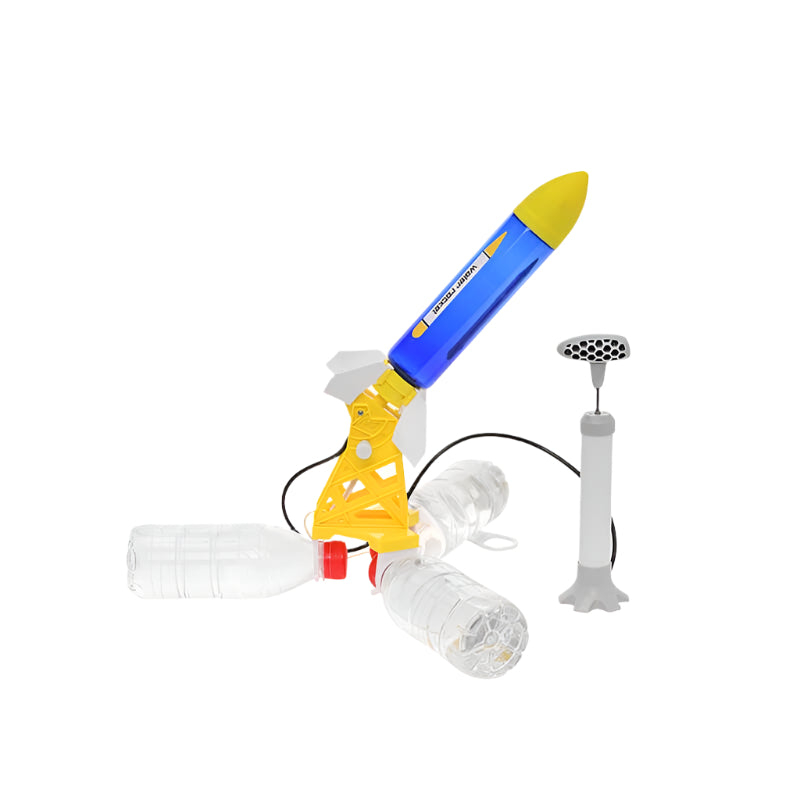
Water powered rocket set with launchpad, air pump, and rocket body for STEM outdoor experiments

Kit for This Project

Ready to test your ideas? Grab the kit used in this experiment and start discovering!

Shop This Kit

The Big Question

How does the launch angle affect the horizontal distance a water rocket travels?

Make Your Prediction

Imagine launching your rocket at three different angles. Which angle do you think will send it the farthest: 30°, 45°, or 60°? Make a prediction and explain why you think that angle will work best.

What You'll Need

• PlaySTEAM Water Rocket kit, including rocket, pump, and launcher
• Water
• Measuring tape (long enough to measure the flight distance)
• Launch-angle markings or a protractor, if needed
• Paper and pencil
• Large, clear outdoor launch area
• Adult helper and safety glasses
• Three water-filled bottles to stabilize the launcher, as shown in the manual

Let's Experiment!

  1. Choose a large, clear outdoor area and ask an adult to help supervise your launches.
  2. Assemble the rocket and launcher according to the manufacturer's instructions. Stabilize the launcher as directed.
  3. Measure a consistent amount of water and add it to the rocket. Use the same amount for every launch.
  4. Set the launcher to 30°, if the kit allows that angle. Mark your launch position.
  5. With adult supervision, use the same number of pump strokes for every launch, staying within the manufacturer's limits. Launch the rocket as instructed.
  6. Measure the horizontal distance from the launch point to where the rocket first touches the ground. Record your result.
  7. Repeat the launch three times at the same angle.
  8. Change the angle to 45°, keeping the water amount, pump strokes, and launch position the same. Repeat three launches.
  9. Repeat at 60°, if supported by the launcher.
  10. Calculate the average flight distance for each angle. Make a bar graph and compare your results.

What Are We Measuring?

What you change (independent variable): The rocket's launch angle.

What you measure (dependent variable): The horizontal distance from the launch point to the rocket's first landing point.

What stays the same (controlled variables): The rocket, amount of water, number of pump strokes, launcher location, and measurement method.

Science fair tip: Complete at least three launches per angle and calculate the average distance. Wind can affect your results, so try to test under similar calm weather conditions.

The Science Behind It

A water rocket launches because pressurized air pushes water out of the rocket. The water moves downward and the rocket is pushed in the opposite direction. This demonstrates Newton's Third Law of Motion.

The launch angle changes how the rocket's motion is divided between traveling upward and traveling forward. A steeper angle usually sends more of the rocket's motion upward, while a shallower angle sends more forward.

In a simplified model without air resistance, a 45° launch angle produces the greatest horizontal range when launch and landing heights are equal. Real rockets can behave differently because of air resistance, wind, and changes in launch conditions.

Think about it: Which angle sent your rocket the farthest? Did your results match your prediction? What might explain differences between launches at the same angle?

Ready to Be a Scientist?

Every great scientist records their discoveries! Download your free experiment worksheet to make a prediction, track your results, and explain what you learned.

Download My Worksheet

Ready to Try It Yourself?

Get the kit and start your science fair adventure!

Shop This Kit