How Does Water Affect Rocket Flight?

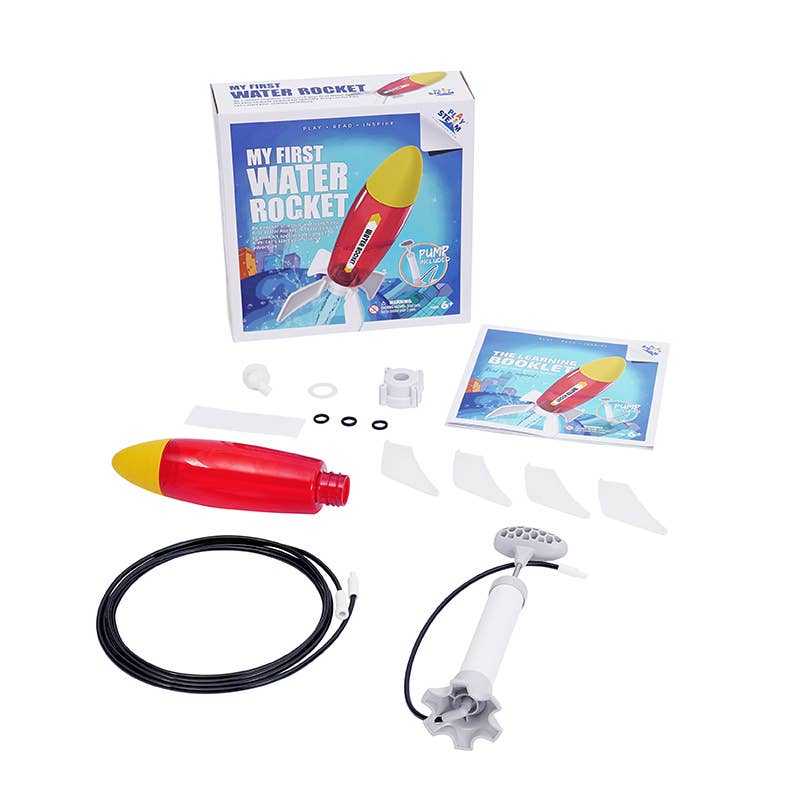
My First Water Rocket STEM science set with easy assembly, pump launcher, and learning booklet.

Kit for This Project

Ready to test your ideas? Grab the kit used in this experiment and start discovering!

Shop This Kit

The Big Question

How does the amount of water inside a water rocket affect how far it flies?

Make Your Prediction

Do you think a rocket with more water will fly farther, or will a rocket with less water travel the greatest distance?

My Hypothesis: If I increase the amount of water inside my rocket, then it will travel __________ because __________.

What You'll Need

• Water rocket launcher and rocket
• Water
• Measuring cup
• Bicycle pump with pressure gauge (if required by your launcher)
• Measuring tape (at least 50 feet)
• Notebook and pencil
• Safety goggles
• Large, open outdoor area
• Adult supervision

Rubber Ducky Dojo Tip: Use the same rocket and launcher for every test to make your experiment fair!

Let's Experiment!

  1. Prepare Your Rocket: Find a large, open outdoor area with an adult. Set up your water rocket launcher according to the manufacturer's instructions.
  2. Choose Your Water Levels: Decide on three amounts of water to test. For example, try filling your rocket to ¼, ⅓, and ½ of its capacity.
  3. Start Your First Test: Add the first measured amount of water to your rocket.
  4. Get Ready for Liftoff: With adult help, pressurize the rocket to the same safe pressure for every launch, following your kit's instructions. Keep the launch angle the same each time.
  5. Launch! Stand clear and launch your rocket. Measure the horizontal distance from the launch point to where it first lands.
  6. Repeat Your Test: Launch the rocket three times using the same amount of water. Record the distance of each flight.
  7. Change the Water: Repeat the experiment using your second and third water levels. Remember to keep everything else the same!
  8. Calculate Your Results: Find the average distance for each water level by adding the three distances together and dividing by three.
  9. Discover the Winner: Which amount of water helped your rocket travel the farthest?

Safety First! Always have an adult supervise launches. Never aim a rocket at people, animals, buildings, or roads. Use only the rocket's manufacturer-approved pressure and launch procedures.

What Are We Measuring?

Every great science experiment has variables!

Independent Variable (What You Change):
The amount of water inside the rocket.

Dependent Variable (What You Measure):
The horizontal distance the rocket travels.

Controlled Variables (What Stays the Same):

  • Same rocket and launcher
  • Same air pressure for every launch
  • Same launch angle
  • Same launch location
  • Same measuring method
  • Similar wind and weather conditions

Why Does This Matter?

Changing only one variable helps you figure out whether the amount of water really makes a difference in your rocket's flight!

The Science Behind It

The Science Behind the Blastoff!

Have you ever wondered how a rocket can launch into the sky using just air and water?

It's all thanks to Newton's Third Law of Motion: For every action, there is an equal and opposite reaction.

When pressurized air pushes water out of the bottom of your rocket, the water shoots downward. This creates an upward force called thrust, which sends your rocket flying!

But here's where things get interesting...

Too Little Water: There may not be enough water to produce a strong push for very long.

Too Much Water: The rocket becomes heavier, and there is less room for compressed air.

Just the Right Amount: A balance between water and compressed air can help your rocket achieve a longer flight.

The Big Discovery: More water doesn't always mean more distance! Rocket engineers must balance weight, pressure, and thrust to design rockets that perform their best.

That's exactly what you're investigating in this experiment!

Real-World Connection: Engineers use Newton's laws and carefully balance mass and thrust when designing rockets for space exploration.

Ready to Be a Scientist?

Every great scientist records their discoveries! Download your free experiment worksheet to make a prediction, track your results, and explain what you learned.

Download My Worksheet

Ready to Try It Yourself?

Get the kit and start your science fair adventure!

Shop This Kit